
In January all James Bond movies showed up on Netflix.
There’s no need to mention that the Bond movies are stocked with characters, quips, lines, plots, and locations that have since become their very own tropes. Even those people who watch no movies at all would have passing knowledge of the cars, the girls, the gadgets, the theme songs, and that he prefers his martinis “shaken, not stirred”.
James Bond is, in one word, an institution.
Everyone knows that 007 has a licence to kill. Everyone knows Bond. James Bond.
As for me, I grew up when it was Roger Moore who was firmly in the role of James Bond, and his run was considered spectacular popcorn entertainment. I had a weak spot for Moonraker (because space!) and, according to personal records, 1983’s Octopussy was the first one I paid pocket money to see as and when it came out while most of the earlier ones gradually got their due on TV, at the Mini Cine One, or via borrowed VHS tapes. Sure, there were gaps; I never made an active effort to see every single James Bond movie (especially the earlier ones) — nor did it really matter to me.
Sean Connery was my parents’ James Bond. His movies were silly. The Timothy Dalton ones seemed “weird” to me, and I remember how we all cheered for Pierce Brosnan when he finally got the role after he was done with the Remington Steele TV series. I also remember that Brosnan’s stint initially disappointed me — but when Daniel Craig took over, the character assumed a completely new dimension. Although I never regarded James Bond to be “great” movies in the least (let alone “art”), Craig’s tenure was fantastic. His Bond had an origin, and he had an end.
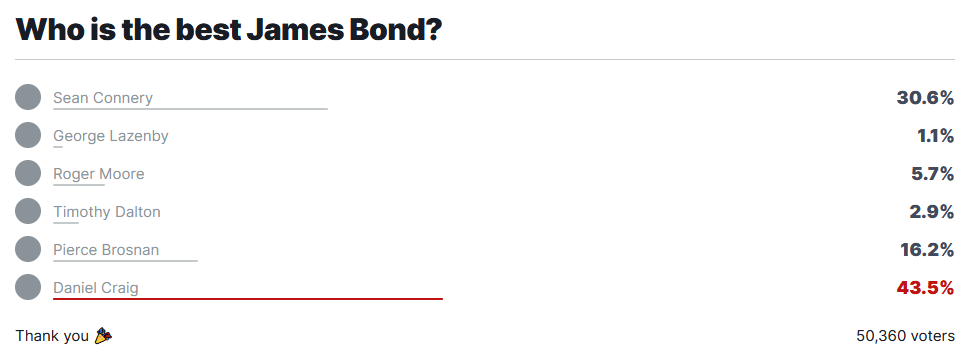
After his Casino Royale debut blew me out of the water, we made sure to see (most of) the rest on the big screen too. Craig’s predecessors were pale prototypes to his performance as a broken and flawed killer who ultimately dies. Connery crawled out of the ooze so that Lazenby, Moore and Dalton could walk before Brosnan learnt to run and Craig could attempt parkour.
So here we are, in the year 2026. While the world eagerly waits for the role to be recast and the series rebooted again, I finally got the chance to watch the entire series — all 25 official Eon Productions (plus that other one) in proper chronological sequence, in context, and through the eyes of a mature man who occasionally nodded off and had to rewind.

Living in 2026 also means that I have access to tools and gadgets old Q himself could never have dreamt of. The first order of the exercise was to ask AI for a list of all James Bond movies + starring actor + director (pretty standard stuff that I could’ve sourced from many other places) but what made the entire exercise even more interesting, as the casual conversation with that same AI chatbot progressed, was the lengthy banter and detailed discussions; the back and forth between her (yes, it’s a her) and myself about the public reviews and whatever literature she was trained on, the occasional confabulations she spun, and my own personal observations and recollections from the actual viewing.
What I attempted to do was view each movie (irrespective of when or whether I had seen it before) through contemporary eyes. I figured that an AI chatbot would’ve been the perfect tool to help provide the proper context.
The franchise is not great art. It is a sixty-year cultural document, commercially driven, accidentally honest, occasionally transcendent, frequently mediocre, and entirely irreplaceable as a record of what the twentieth century thought a certain kind of man should be. […] He’s a relic, a fantasy from a supposedly simpler time when men were men, women were decorative, and geopolitical conflicts could be solved by one well-dressed spy with improbable gadgets.
Dr. No (which I’d never seen in its entirety before), for instance, should have been viewed as 1962 audiences might have experienced it, with the mindset of the general western population at the time, in the contemporary historical, sociopolitical and cultural context — in the period of U2 spy planes, the Cuban missile crisis, when JFK was US president, and before Beatlemania. MI6 served Queen and country, TV was in black and white, and air travel was something reserved for the rich and glamorous.

It was a different time. I tried to understand it through watching James Bond movies, and it soon became clear to me that the character “embodied the imaginary possibility that England might once again be placed at the centre of world affairs during a period when its world power status was visibly and rapidly declining.” James Bond is a time capsule.
Bond as period document: Each era is a cultural thermometer of its time. Connery — early Cold War masculine mythology. Moore — détente and camp spectacle. Dalton — late 80s moral realism. Brosnan — post-Cold War identity anxiety, peaking at GoldenEye, collapsing at DAD.
I was equally curious to see if and how the producers explained the replacement of one actor/actress by another, where and how certain terms and clichés originated, and the overall 40-year continuity of the entire “classic series” (pre-Craig). I must also disclose here that I’ve not read a single one of the original Ian Fleming novels. Wikipedia has its own dedicated pages on how well James Bond, the literary character, was translated to James Bond, the movie character.
The biggest revelations for me, however, were what complicated and chaotic endeavours the production of each individual movie turned out to be, mostly due to bickering rights holders and legal injunctions (although Casino Royale is the establishing novel, it was never filmed in the classic series). The murder of Bond’s wife barely gets mentioned afterwards (twice only, in passing, by my count), multiple actors’ and actresses’ voices were dubbed over due to their thick accents (it is not Gert “Goldfinger” Fröbe who expects Mr. Bond to die, and we get to admire Ursula Andress’ bikini but never hear her voice), actors had previous commitments (hence Dalton getting his turn), and, worst of all, characters constantly changed faces, hair, and earlobes (with Charles Gray, Telly Savalas, Donald Pleasence and other unseen ones in the prominent role of Ernst Blofeld). And don’t get me started on CIA colleague Felix Leiter!
Here’s how my chatbot summarised our discussion of On Her Majesty’s Secret Service:
The film the franchise stumbled into rather than planned — rookie actor, a director doing his only Bond, a shrinking budget — and the most emotionally honest entry the classic era produced. Lazenby had zero acting experience, lied his way into the role with a borrowed suit, and still managed what neither Connery nor Moore quite pulled off: making you believe Bond was in love. The romance with Tracy works because Diana Rigg does the heaviest lifting in franchise history, and Lazenby meets her with a vulnerability his inexperience couldn’t fake. The Alps ski chase is the finest action sequence the classic era produced — real stunts, real mountains, no net. Telly Savalas’s Blofeld can actually fight, physically credible in ways his predecessor wasn’t — same cat, different face, zero explanation, a franchise that’s never once been embarrassed by its own continuity wreckage. The villain plot is weak — agricultural terrorism via brainwashed women, YOLT-level nonsense without YOLT’s production design to cover for it — but it doesn’t matter, because the engine here is Bond and Tracy, not SPECTRE’s annual scheme to inconvenience the planet. Lazenby quit after this on famously bad advice and spent decades publicly regretting it; he should have gotten three more films to become what this one only suggests. Instead the franchise panicked, bought Connery back with money, and made Diamonds Are Forever. The cat survived. It always does.
If you want to read her individual synopses of all 21 classic movies, check this text file.
Like I said, the James Bond film franchise is a far more complicated piece of machinery than I had realised, with so many critical moving components that each deserves to be analysed individually with regard to things like the basic plot and/or the villain’s scheme (that usually touches or entirely dodges contemporary issues); the pre-title sequence; the gun barrel sequence (the first three of which didn’t even feature Connery himself); the gadgets introduced (“Chekhov’s guns” that get used in that one movie and never again — despite their effectiveness); the deaths of the villain and the henchman (because every villain has a henchman, and they typically get offed separately and through poetic justice); the title song and sequence; and, of course, the Bond girls — rated on physical hotness as well as character, charm, and agency.

That title goes to Sophie Marceau, and, much to my own surprise, Pierce Brosnan eventually became my favourite Bond (until Daniel Craig came along, that is).
Connery: Charisma and physicality. Best in FRWL. Embarrassing by DAF. Stopped caring. Lazenby: Underrated. One film is unfair. OHMSS better than its reputation. Moore: Charm mistaken for acting. Best in FYEO. Should have stopped before AVTAK. Dalton: Best raw acting chops. Structural tragedy — legal issues killed the momentum. LTK is his peak and the franchise’s most emotionally raw film. Brosnan: Against expectations, my favourite Bond. Composite of all predecessors — Connery’s cool, Moore’s ease, Dalton’s darkness. Critically undervalued. GoldenEye is his masterpiece and [almost] the best pre-Craig Bond film. Deserved better than DAD as a final film.
Countless books, documentaries, online articles, listicles and YouTube videos on the topic exist. There’s no point in me retreading this ground in more detail now, so let me simply reveal my own ranking of the pre-Craig films that surfaced after this initial round:
(Rank | Title | Year | Director | Bond Actor)
TOP TIER (3.5/5)
- 1 | From Russia with Love | 1963 | Terence Young | Sean Connery
- 2 | Never Say Never Again | 1983 | Irvin Kershner | Sean Connery
- 3 | On Her Majesty’s Secret Service | 1969 | Peter R. Hunt | George Lazenby
- 4 | For Your Eyes Only | 1981 | John Glen | Roger Moore
- 5 | GoldenEye | 1995 | Martin Campbell | Pierce Brosnan
- 6 | Licence to Kill | 1989 | John Glen | Timothy Dalton
MID TIER (3/5)
- 7 | The Living Daylights | 1987 | John Glen | Timothy Dalton
- 8 | Tomorrow Never Dies | 1997 | Roger Spottiswoode | Pierce Brosnan
- 9 | The World Is Not Enough | 1999 | Michael Apted | Pierce Brosnan
- 10 | Octopussy | 1983 | John Glen | Roger Moore
- 11 | The Spy Who Loved Me | 1977 | Lewis Gilbert | Roger Moore
- 12 | The Man with the Golden Gun | 1974 | Guy Hamilton | Roger Moore
- 13 | Thunderball | 1965 | Terence Young | Sean Connery
- 14 | Live and Let Die | 1973 | Guy Hamilton | Roger Moore
- 15 | Dr. No | 1962 | Terence Young | Sean Connery
- 16 | Goldfinger | 1964 | Guy Hamilton | Sean Connery
- 17 | A View to a Kill | 1985 | John Glen | Roger Moore
BOTTOM TIER (2 to 2.5 of 5)
- 18 | Die Another Day | 2002 | Lee Tamahori | Pierce Brosnan
- 19 | Moonraker | 1979 | Lewis Gilbert | Roger Moore
- 20 | You Only Live Twice | 1967 | Lewis Gilbert | Sean Connery
- 21 | Diamonds Are Forever | 1971 | Guy Hamilton | Sean Connery
Every classic Bond actor managed to claim a spot in the top six. This was not expected.
Each movie was judged on its own merit and rated (out of five stars) against all movies I’ve ever seen, and the ranking is by no means final: the exercise must be repeated someday, in more detail. Some day. Whenever. The scores and rankings are likely to change slightly. During this round, Goldfinger underwhelmed me (despite its iconic status) and yes, Never Say Never Again actually had a lot going for it.
Oh, and one more thing: If I had to rank the film posters, this one would come out tops. Awesome kitsch!

I would pay money for a decent print to frame on the wall.
Even if there’s no cat.
Hover for image credits.


